"Women were unwelcome, but male architects couldn't live without"
At MOMA the exhibition about women's role in postwar Modernism
Museum of Arts and Design, New York
#Art & Culture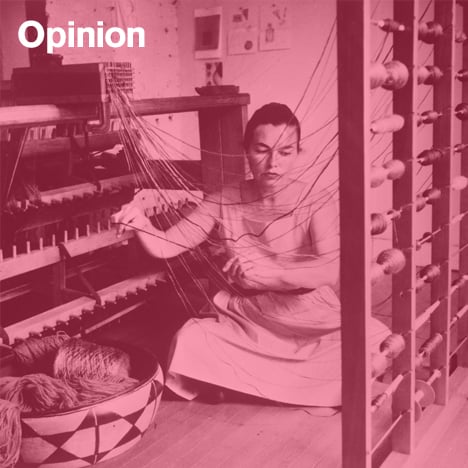
The journalists, artists and curators at the press preview for the Museum of Arts and Design's new exhibition, Pathmakers: Women in Art, Craft and Design, Mid-century and Today, were about 90 per cent female – an unusually high percentage, according to the museum's publicist.
But the imbalance seemed about right, in that it reflected the continuing, uneasy, and gendered relationship between people who make things out of yarn, clay or cloth and people who make things out of glass, steel or plastic. The editors of a few blogs seemed unsure whether the contents of the show – four hanging woven-wire sculptures by Ruth Asawa, screen-printed geometric textile designs by Anni Albers, a test panel for the gold-embroidered tapestries for the Ford Foundation by Sheila Hicks, along with work by 39 other artists – even counted as "design" for their purposes.
"In the 1950s and 1960s, an era when painting, sculpture and architecture were dominated by men, women had extensive impact in alternative materials such as textiles, ceramics and metals," reads the wall text.
Starting with the Bauhaus weaving workshop, eventually led by the supremely talented Gunta Stolzl, modern women with visual talent were shunted into creative professions closer to traditional women's work, and many of them found what they made then treated as lesser-than. Half of MAD's collection is work by women, and with this exhibit, curated by Jennifer Scanlan and Ezra Shales, the museum hopes to expand ideas about who, and what, constitutes mid-century design.
While women were largely unwelcome in architecture and industrial design, male architects and manufacturers found they couldn't live without them
The problem of terminology has bedeviled this work from the start. When the Museum of Modern Art first showed fibre art in the 1969 show Wall Hangings, artist Louise Bourgeois wrote, in the magazine Craft Horizons, "the pieces in the show rarely liberate themselves from decoration." Fear of fibre, it seems, lives on.
The irony is that, while women were largely unwelcome in architecture and industrial design as practitioners, male architects and manufacturers found they couldn't live without them. Most of the highlighted mid-century designers worked with architects to bring nature, texture and colour to their hard-edged spaces, and several worked with manufacturers as designers and translators – for publicity purposes – of new styles and materials for a mass audience.
I do wish the exhibit had included photographs of more of the architecturally-scaled works by the featured artists. (At home, you can use Google.) Beyond Hicks there's also ceramicist Edith Heath, whose company made tiles for Roche Dinkeloo's Ford Foundation and Eero Saarinen's Deere & Co. Headquarters; longtime Cranbrook teacher Maija Grotell, whose experiments with enamel glazes can be seen on the Technicolor end walls at Saarinen's General Motors Technical Center; and Finnish ceramicist Rut Bryk, who created a monumental map-like bas relief for Helsinki City Hall.
It wasn't only women whose work was used by architects in this manner. I would argue that Harry Bertoia and Alexander Girard's work provided the same touch of the hand in buildings like the Tech Center cafeteria, or corporate installations for Hallmark and Cummins.
It wasn't only women whose work was used by architects in this manner
In his New Yorker review of SOM's Manufacturers Hanover Trust, Lewis Mumford noted, of Bertoia's room-spanning bronze screen: "Though [Bertoia's screen] is purely abstract, making no effort at symbolic significance, it humanises these quarters even more effectively than living plants, mainly because it suggests something frail, incomplete, yet unexpected and defiant of rational statement, and thus lovable, a note that is not audible in most of the representative architectural expressions of our time."
Tags:
#Art & Culture
- David Annesley's flying colours
- Perego and Conte's photography captured the geometric essence of La Grande Motte
- 'Festival of Life': Yayoi Kusama's new multi-sensory exhibit
- Teamlab's 'Living Digital Forest' installation brings flowers to life
- A world of polka dots: Yayoi Kusama opens museum in Tokyo
Related Articles
- David Annesley's flying colours
- 'Festival of Life': Yayoi Kusama's new multi-sensory exhibit
- Teamlab's 'Living Digital Forest' installation brings flowers to life
- "Treasures from the Wreck of the Unbelievable": Hirst's exhibition in Venice
- “The Iris”: a celebration of ephemeral art by Rebecca Louise Law